Opening balances
Bring a business in from another system by setting one date, each account's balance and where the other side goes.
An opening balance is what an account held on the day before you started in TrueSum. To bring a business in from a spreadsheet or another program, give every account its balance on one date. TrueSum then starts with the books as they stood.
Choose the date
Use the day before your first transaction in TrueSum, ideally the last day of a month or a year, because your old books have totals for it. Use the same As of Date for every account. TrueSum proposes the day before each account's first transaction, so change the proposed date to match the others. It cannot be in a year you closed.
Enter each balance
- Open the account and find Opening Balance in Account Details.
- Type the balance from your old books on that date. For a credit card, type what you owed. A negative balance on a bank account is an overdraft.
- Press As of Date, which appears once there is a balance, and choose the date.
- Press Save.
Do this for your bank accounts, credit cards, fixed assets, loans, customers (what they owed you) and vendors (what you owed them). To change one later, change it in Account Details and save. Set it to zero to remove it.
Where the other side goes
Every transaction has two sides (see How TrueSum keeps the books). TrueSum saves an opening balance as a transaction dated on the As of Date, described "Opening balance", and puts the other side in Opening Balance Equity.
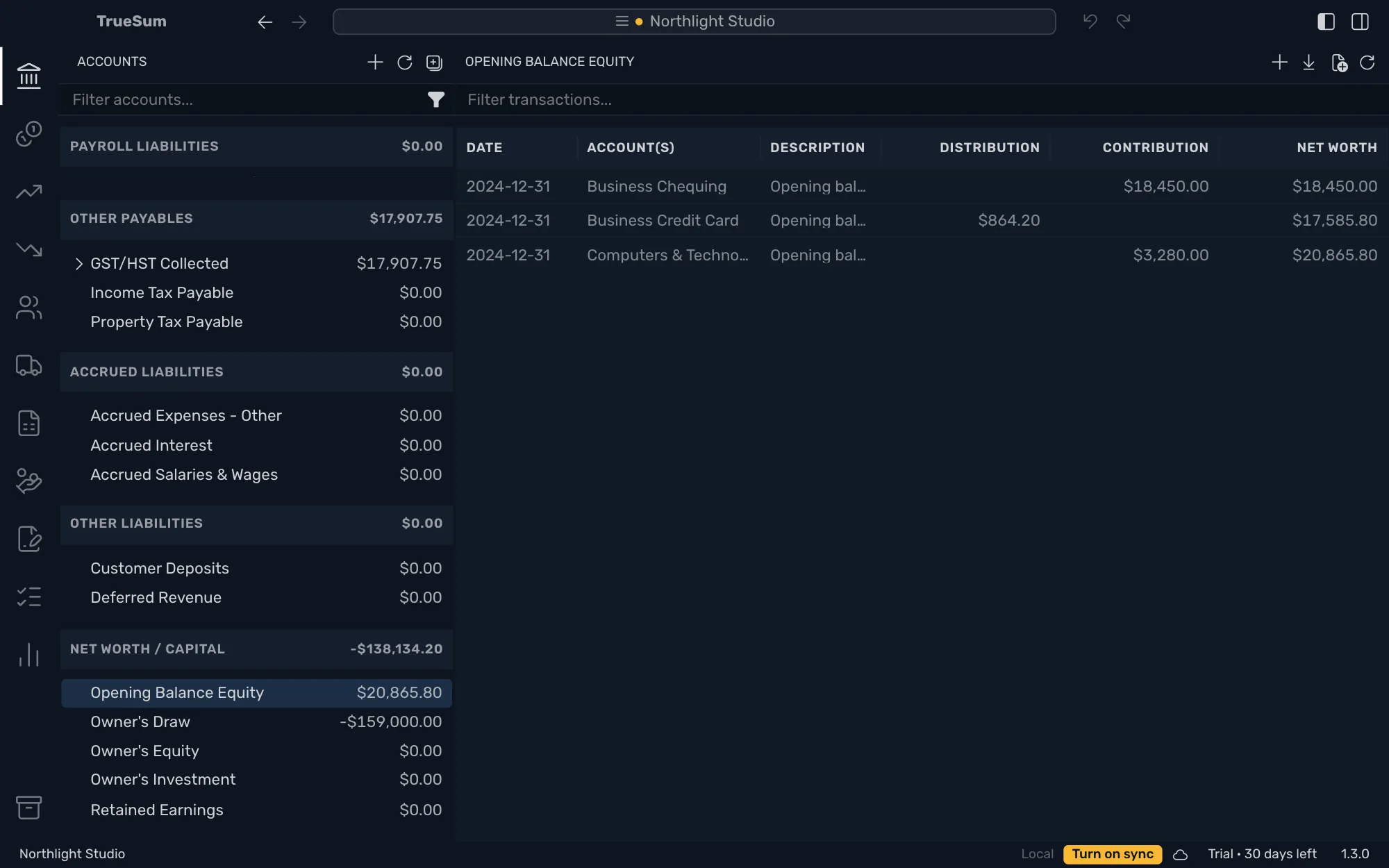
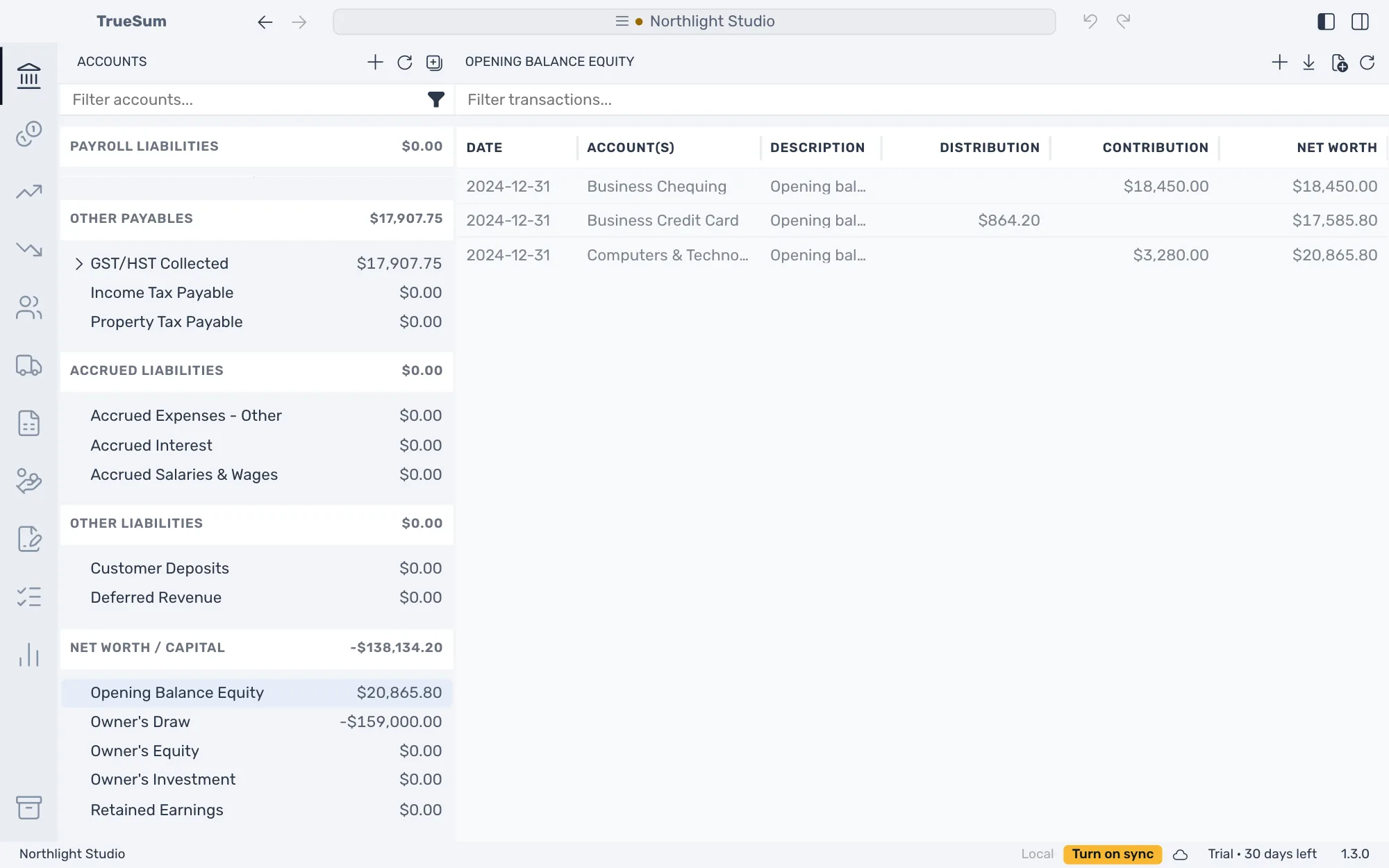
An equity account's columns are Distribution (money out), Contribution (money in) and Net Worth.
Opening Balance Equity ends up holding what the business was worth on that date, which is what it owned less what it owed. Open the Balance Sheet as of the date and compare it with your old books. You cannot post to this account yourself. TrueSum says "Opening Balance Equity is filled in from accounts' opening balances. Set an account's opening balance in its details instead."
When you close a year, its balance moves to Retained Earnings (see Close a fiscal year).
Customers and vendors
A customer's opening balance is saved as an invoice, and a vendor's as a bill, so a payment can pay it. The other side is Uncategorized Income or Uncategorized Expense, not Opening Balance Equity. These are income and expense accounts, so the amount counts in the period of the As of Date on an Accrual report, and when it is paid on a Cash one. That period's Profit & Loss then includes it. If that is not what you want, ask your accountant how to handle it.
An account in another currency shows both amounts and the rate (see Accounts in another currency).